How do we create meetings that deliver more value than they cost?
“Could you say that again?” “We can’t hear you in the room.” “What did we actually decide?”
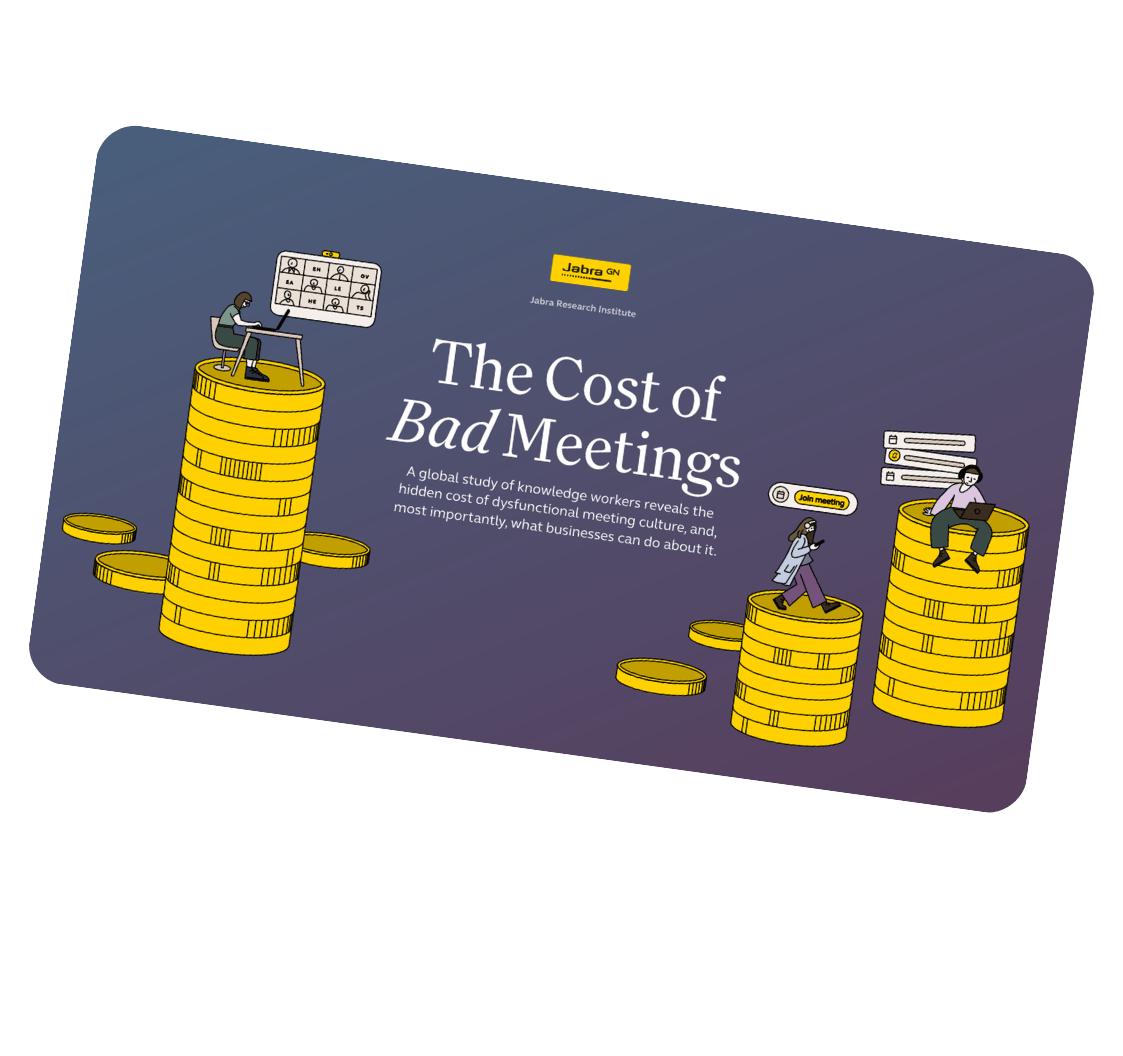
Many of us can relate, and the consequences of technical issues go beyond a few lost minutes. A report from the Jabra Research Institute shows how shortcomings in meeting culture and technology affect working time, energy and people’s ability to participate.
Meetings are essential for making decisions, solving problems and moving work forward. Yet sometimes we leave the meeting room with more questions than answers.
In the report The Cost of Bad Meetings, respondents say they spend an average of eight hours a week in meetings. As much as 58% of that time is considered unnecessary. According to the report’s calculations, this amounts to around 26 working days per person each year.
This raises an important question: how do we create meetings that give back more than they take?
An unclear meeting costs time even after it ends
The cost of a bad meeting doesn’t end when the meeting does.
According to the report:
65%
of workers regularly leave meetings with unclear action items.
59%
need a follow-up meeting as a direct result.
59%
generate additional work to recover from the confusion.
When technical issues become part of everyday work
A meeting starts a few minutes late because the audio isn’t working. Someone needs to switch connections. A remote participant misses part of the conversation and asks for it to be repeated.
On their own, these problems may seem minor. But when they keep happening, they disrupt the flow of the meeting and affect participants’ focus.
According to Jabra’s report, three out of four hybrid meetings experience at least one technical issue. The report’s calculation model estimates that almost eleven minutes per hybrid meeting are lost to technical problems.
Good meeting technology therefore needs to suit how the room is actually used. How many people will take part? Where will they sit? Do they need to move around and present? And what is the meeting experience like for someone joining remotely?
The answers to these questions help determine the right audio, display and video solution.
Being connected isn’t the same as being included
In a hybrid meeting, participants share the same meeting, but don’t always have the same opportunities to take part.
Those in the room can pick up on quiet comments, see who wants to speak and follow conversations around the table. For someone joining remotely, the same situation can be much more challenging.
In Jabra’s survey, around half of remote participants say they regularly feel forgotten, talked over or excluded.
Clear audio and video that makes the conversation easy to follow are therefore essential for participation. At the same time, the meeting host needs to actively invite remote participants into the conversation and ensure that everyone can follow discussions in the room.
A good hybrid meeting needs to work on both sides of the screen.
AI needs a good meeting to work with
AI can help summarise meetings, transcribe conversations and capture action items. In Jabra’s survey, 75 per cent have tried AI-generated meeting summaries, but only 27 per cent use them regularly.
One of the biggest barriers is trust in the accuracy of the results.
The report’s message is that AI needs a solid foundation. If participants cannot be heard clearly, talk over one another or leave decisions unclear, the input for AI also suffers.
Good audio, effective meeting facilitation and clear decisions are therefore just as important when AI becomes part of everyday meetings.
Start with the purpose of the meeting
Not every meeting needs the same format. A decision-making meeting, a workshop and an information update serve different purposes and need different approaches.
Sometimes, a meeting is the right choice. In other cases, an email, an intranet update or a recorded presentation works better.
For meetings that do need to take place, a good starting point is to:
Clarify what participants should get out of the meeting.
Adapt the format and technology to the room and the way people work.
Ensure everyone can hear, be seen and contribute.
Document decisions and next steps.
Follow up on recurring technical issues so they can be resolved.
The cost of a bad meeting doesn’t end when the meeting does.
Read the full report today!
We help you create better meeting spaces
At AVS, we start by understanding your organisation and how you want to work. Based on your needs, we help you create meeting spaces where audio, display and video technology support the conversation.
We support you throughout the process – from needs analysis and consultation to installation, commissioning, training and service.
Do these challenges sound familiar? Contact us at AVS, and together we’ll explore how your meeting rooms can better support clear, inclusive and effective meetings.











.jpg?width=1123&height=1056&name=Jabra%20kunskapshub%20(1).jpg)
.jpg?width=1123&height=1056&name=Jabra%20kunskapshub%20(3).jpg)
.jpg?width=1123&height=1056&name=Jabra%20kunskapshub%20(4).jpg)



.jpg)